Showing posts with label George Grosz. Show all posts

Friday, September 30, 2011

In the Spirit of Healthy Dissent

Michael in front of the House of Burgesses,
Williamsburg, VA, mid-September 2011.
A few weeks ago, when Michael and I were in Williamsburg, I picked up a few pamphlets, one of which was printed on the Foundation's colonial-era, moveable-type printing presses. One of the hand-stitched booklets I purchased was Common Sense by Thomas Paine. Another was Poor Richard's Pamphlet No. 11: An Anonymous Account of the Boston Massacre. And finally, I also bought the slender, Williamsburg-printed Summary View of the Rights of British America Set Forth in Some Resolutions Intended for the Inspection of the Present Delegates of the People of Virginia Now in Convention, written by a "native member of the House of Burgesses". What's the House of Burgesses, you ask? It was Williamsburg's (and by extension, Virginia's, governing body, where elected officials presided for a greater part of each year). It is bicameral, with two parliamentary chambers, one dealing with British colonial concerns and the other with Virginia's localized conerns). I include a picture of Michael, standing in front of one side of the House of Burgesses. The circular window indicates that it was a governmental building.


Revolutionary pamphlets with hand-sewn quires, no bindings
I find a great deal of inspiration in these old printing processes and incendiary pamphlets, compositions that fuelled the Revolution. It's also compelling evidence that language is truly an agent of change. Yet now, things have altered so radically within the last fifteen years, that it seems print is completely obsolete. How do you distribute revolutinary material now? Of course, via the internet. Not only do you have a greater broadcasting capacity, but the cost is minimal. And yet, yet...there are so many people distributing "revolutionary" (the air quotes appear around revolutionary on purpose) material that it's difficult to be heard at all. The sheer number of voices undercuts almost every message but those voiced by the loudest or most popular figures. Of course, the internet promotes democratic expression of ideas, and this is wonderful. At the same time, however, voices that have genuinely compelling and thoughtful messages are often lost in a cacophony of pseudo-intellectual noise and other totally opinionated garbage.

Inside the printer's shop, Williamsburg, VA
mid-September 2011.
A few years ago, for ZMagazine, I wrote a review of Signs of Change, an exhibition charting the modern history of international revolutionary paraphenalia. You can read the review here. I started the essay with a quote by George Grosz, a quote that I pulled from his 1925 essay "Art is in Danger". Grosz wrote, "...come out of your seclusion, let the ideas of the working people take hold of you and help them fight this rotten society." Here, Grosz was telling the intellectuals to come down from their ivory towers and get involved in a progressive movement to effect positive social change. He wrote this shortly after the rampant inflation that crippled much of Germany. Perhaps more significant is that he wrote it after he had been to Russia, saw the impact of Communism on the people, and had begun to stray from its ideology. 

I still find Grosz's quote to be significant, particularly as a writer. Do I believe in art for art's sake? Without question. But I feel that at least some artists and writers have a responsibility to engage in a kind of political warning system...that is, extrapolate from the data we have--in this case, particular elements of the status quo--and determine where these current variables might lead us should they persist. For example, (these are, of course, very specific and narrow variables) if students continue not to care about their studies, if they continue to collect their Pell grants and government funds without investing the time necessary to earning degrees, if they are never taught (or never absorb and understand) the fundaments of our political system, if they continue to cling to restrictive labels that facilitate their movement through the education system without truly working for what they receive, what will happen to us as a nation? How easily can we be conquered by savvy (even not so savvy) manipulators, who tell us what we want to hear? Is this what the men writing revolutionary pamphlets--including The Declaration of Independence--had in mind? Did they expect that we would be come a nation of slackers, surly and opinionated but unable to produce any factual details to substantiate them, even though they are often expressed with both middle fingers raised?  

Moveable type printing press, Williamsburg, VA
mid-September 2011.
 It's this realization that makes me want to write. I imagine where these variables, if unchanged, will lead us. As I mentioned in the previous post, this is why I wrote "Conceived in the New Liberty", where people actually burn copies of The Constitution because they are manipulated into believing it no longer works for the nation (and because burning the facscimiles gets the attention of television crews, who offer a kind of fleeting celebrity). This becomes the point at which the country descends into martial law. I myself see this descent coming, and in some ways, it's already here. Other writers have seen this potential, too. Take Vonnegut's Player Piano for example, or better yet, Orwell's Animal Farm. I wonder, are students even required to read this book anymore? And if they are, would they understand its implications or would they simply accept it at face value, as a story about talking animals in a farm yard? I truly wonder about this, given my own experiences in the classroom.

In the spirit of revolutionary pamphlets and dispersing views that counter popular notions, I've just purchased some ad space for Literary Outlaw on both Scholars and Rogues and Liberty News Forum. I've done this before, specifically for American Soma, which helped me sell two copies (one of which went to England) and landed me an interview with Jeff Farias on his radio show. At the time, I advertised on Truthdig, but their rates have gone up exponentially. What had, in 2009, cost $50, now costs $400. So I opted for something more economically viable for my piggy bank. We'll see if these two blogs accept the ad, first of all (for ads must be approved before running), and what traffic it might generate. We shall see....

Wednesday, July 13, 2011

Things I understand with age

George Grosz at work
During my year in Germany, when I studied in an antiquated building whose most memorable feature was its herringbone parquet floors, I spent a lot of time in the Art History Department's library. I pulled out tomes, translated chapters, and made copies enough to fill several three-ring binders, which I eventually shipped home via the now defunct "Seepost". All of this activity got me closer to learning who George Grosz really was.

Of course, I knew who he was. His drawing, "Fit for Active Service", had been in my mother's college text, H.H. Arnason's History of Modern Art, along with a color plate of the painting, "Pillars of Society." (Arnason's book became something close to a sacred volume for me. I look at it constantly. I once knew the order of the page imagery by heart.) And yet, I did not understand what made Grosz, the man, tick. I felt this was necessary, since I had chosen him as the subject of my thesis. During my first few months at LMU, I made an appointment with a professor in Art History Department and indicated, in my then uncertain German that I wanted to study Max Beckmann. She said, "You will find it difficult to do any original research on Beckman. So many people have already written about him. Why don't you do your paper on someone like...oh, say, George Grosz?"

Why not, indeed. The previous year, I had deferred my Master's Degree at Pitt in order to come to Germany, and I had already met with my future thesis advisor. She was a George Grosz scholar, perhaps one of the most prominent Grosz scholars. I had no misgivings about entering her turf, although some fellow graduate students later questioned my sanity. When I returned home, she and I carved up Grosz' life like it was steak. She got the 19-teens, 20s and early 30s; I got his emigree legacy. And ultimately, I tied Grosz's legacy to another artist, Romare Bearden, Grosz's student at the Arts Students League. But that's another story for another time.

So, the first Grosz I got to know was the Grosz of Second Reich and Weimar-era Germany--the Grosz whose manifestos I read in my apartment at Moosacherstrasse 81. Here was the Grosz of Dada, of Neue Sachlickeit, the Grosz who spent time with John Heartfield and wrote disgustingly boastful journal entries about his sexual exploits with girlfriend (and later, wife) Eva. Also, I got to know the slightly older Grosz who had a sincere commitment to Communism until he saw its realities in Russia. And then there was the Grosz of the blasphemy trials.

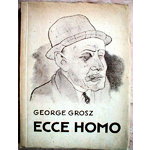
Here, as an aside, I should probably mention that before the story collection American Soma took the name of the principal story (a decision James made, and I don't disgree with), the collection was called Behold! Mankind. Why? Because it is the rough translation of George Grosz's portfolio satirizing mankind's immorality. (I intended no allusion to either Pilate or Nietzsche, only Grosz.)  Ecce Homo, published by Malik Verlag in 1923, was what landed Grosz in trouble with the authorities and, eventually, in court. Because American Soma offered small portraits of man's weaknesses, I felt there was a parallel in spirit and message.  (Also, if you read the story "Movie Star" in my first book, The Famous and The Anonymous, George Grosz appears as a character. I try to fit him into each fiction compilation because Grosz is my literary version of 'Nina'.)
George Grosz, "The Retreat" 1946
Back when I was in Munich, I was young (22 and then 23), determined, not easily daunted. I drank alot, and I saw in Grosz the nihilst, the rabble-rouser, the person who stirred dissent because he was young and prone to rebellion. I recognized a little of myself. 

When I got back to America, I began to discover a different Grosz, a disillusioned man, whose attempts to get away from his highly politicized past were met with criticism. Malcolm Cowley, who reviewed an exhibition of Grosz's American paintings for The Nation in the 1940s, castigated the artist for his decidedly apolitical tenor, for his tepid Cape Cod sand dunes, his comparatively academic nudes. Where, Cowley wanted to know, was the satirist? He was needed now more than ever. Apart from a few images representing the "haves" and the "have nots", Grosz abandoned social issues. 

I couldn't see it when I was 23 and 24, but I understand at 37 that Grosz was a haunted man, a broken man, as evinced by paintings like "The Retreat" of 1946. And knowing about the prescient dream he had in late 1932 that caused him to pack up his home and family and flee Germany before Hitler ascended to the position of Reichschancelor in 1933, it's easy to understand his pessimism. He had already seen that, ultimately, Stalin was little different than Hitler, something he revealed in a drawing appearing in the 1936 portfolio Interregnum. Ultimately, he resigned himself to the realization that man was so bogged down by weakness, desire, and corruption that he could never hope to achieve an equitable social or political system.

Malcolm Cowley, who castigated Grosz for
the artist's apoliticism in America
Why Cowley could not appreciate this, I'm not sure. Perhaps he was himself still an idealist. Perhaps he felt a man could not, or should not change. Grosz's attention to aesthetics over content was a conscious turn away from that which he knew could not be fixed. No amount of propaganda or artistic dissent would change the fundamental, corruptible nature of man. Ecce Homo indeed. Here, it seems, is the disappointing truth about man. Grosz knew this, and it is, I would wager, what contributed to his heavy drinking and, ultimately, his drink-related death.

Tuesday, February 1, 2011

Whatever Happened to Victorine Meurent?

A page from the amazing
"Whatever Happened to Victorine Meurent?"
Read about the comic's artist, Victoria Morris,
at her blog here.
So, I am more or less fully recovered from my bout with the flu, and apart from a terrible coughing fit I experienced while teaching last night, I am again a fully functioning human being. And I have to say: what a delightful thing that is.

Until you're sick, you forget how fantastic it is to breathe through your nose. No, don't laugh. I'm very serious about that. I really dislike being a mouth-breather. It's behavior *affecting a British accent* unbecoming a lady. Ha!

What's this on the left, you ask? Only something totally awesome I found here: Whatever Happened to Victorine Meurent? It's a comic (this is page three, on the left, which details Victorine's early life).

Who is Victorine Meurent, you ask? Only Manet's most enchanting model. And I say enchanting because the girl had some incredible self-possession.

Whether art history likes it or not, Victorine Meurent has become one of Western art's most iconic female figures, despite the fact that this same figure was ridiculed by critics in the worst possible terms when it went on display (in painted form) in the 1870s. But who hasn't somewhere seen Le dejeuner sur l'herbe, where Victorine levels her gaze at the viewer in a way that indicates--even if she were there in person--she would neither blink nor avert her eyes. And surely you've seen Olympia, where she poses as a naked courtesan presented with a gift of flowers from a customer by her maid. These are essential works in any survey of Western art, and sadly, Victorine has likely never gotten to appreciate one iota of her fame.

In fact, Victorine was a painter herself, one who was extremely talented. She exhibited repeatedly in the Paris Salon before even Manet enjoyed acceptance there. But her work was marginalized, perhaps because she was a woman or perhaps because recognition of her face and figure in Manet's paintings created a stir that eclipsed her own professional efforts. By 1879, she had been shut out of Manet's circle because her tendency towards free love incited violent jealousies among the men (I'm sure retrospective telling has toned down the scandal, and at the time, the gossip and examples of wounded pride were much more dramatic).

The comic (again, whose page three is visible above) gives a visual history of Victorine's life, and the author (whose name I haven't been able to find...Who are you? I'd love to give you credit because what you've done is totally wonderful!) has done some amazing excavations to fill in the long informational gaps that exist in Victorine's biography.

Victorine's GLBTQ encyclopedia entry, which I also gleaned from the comic's bibliographic page, indicates that in the early 1890s, she was the "intimate friend" of a courtesan named Marie Pellegrin, but had also turned to alcoholism. Yet, she continued to paint into the early 1900s and was still listed among professional artists. Then, she lived in the suburbs of Paris with a woman named Marie Dufour, a secretary and piano teacher.

Really, period critics, even many art historians have consistently given Victorine a raw deal. I am glad to see that she is not forgotten. She is a kind of hero to me, in the same way that my favorite chain-smoking, baggy-eyed male intellectuals are. She simply was, and although I'm absolutely certain I don't know the whole story behind Victorine's emotional life, she never apologized for being Victorine that I know of. And this is something to celebrate. It really is, since pretty often, life can be tough.

When I was in graduate school, I focused on the German Modernists and my boy George Grosz (whom I realized, sort of looks like Michael...hmmm...coincidence? I don't know.), but I was also lured by the Impressionists....not so much by their painting, but by their milieu: the theater crowds; the demimonde; the horse races, the absinthe, the flamboyant and disgusting beauty of the prostitutes. All of this fascinated me. Still, the frothy atmosphere Monet offered and the ballerina tulle Degas often choked me with made Impressionism somehow less potent than the angry absurdism of the Dadaists or the outright emotionalism of the Expressionists (okay and I dug the Post-Impressionists, too, but I won't get all the swank terms out of my tackle box right now *closing the lid*).

Alias Olympia: A Woman's Search for Manet's Notorious Model & Her Own DesireAnyway, anyway, this, this is a really good book. I read it in graduate school: Alias Olympia: A Woman's Search for Manet's Notorious Model & Her Own Desire. Eunice Lipton goes over to Europe and finds primary source documents in her atttempt to trace the path of Victorine. There's some self-revelation there and some "navel-gazing", but most importantly, Victorine begins to come to life again. 
It is sad that so little information still exists on Victorine. Even her paintings are largely lost, with the exception of one that sold for around $5,000 in the 1930s. Not a bad price, given that it was the beginning of the Depression. Still, no one can account for her work now, at least to my knowledge. I hope very much that a few of these paintings still exist and are just quietly waiting to re-emerge somewhere on one side of the big pond or the other.