Wednesday, July 27, 2011

And for humorous purposes....

"Bastards won't give me tenure."
These delightful animatronic figures are for sale this week at an auction located near Steubenville, Ohio. Michael found them on Auctionzip.com. These darlings were once part of moving window displays erected in commercial venues. Really, I'll say no more, and allow them to speak for themselves. They have so much to say.


Celebrity Rehab: The Sesame Street Edition

Thursday, July 21, 2011

General Doings...

It's Thursday and incredibly hot, a fact we have been unfailingly alerted to and reminded of by the news for the past week. I can look out our living room window, from where I'm writing this post and see trees and haze. The ciccadas are screaming, so that (according to popular lore) means there are only six more weeks of this hard-to-breathe, quick-to-sweat searing thickness. We hope. To heal my broiled (and now perspiration-drenched) spirit, I envision approaching surf and cooling breezes. Happy place, yes. 
O Fallen Angel
Kate Zambreno's
first novel, O Fallen
Angel
.


Kate Zambreno's wonderful blog (like this post or this one) always reconnects me with what it means to be a writer. She is a thinking writer, an intellectual, very analytical, but also forceful in her emotion, and sometimes her uncertainty. At her blog are the best three parts of humanity: head, heart, soul. More on her new book Green Girl very soon...

What I worked on from 7:33 A.M. until about 11:30 today is "Conceived in the New Liberty", a fictional commentary on how easily we might allow our rights be dismantled. I'm happy that it's flowing pretty steadily.  During my daily hour of penance on the exercise machines in the basement, I flip between HLN, CNN, and Fox (all three are on consecutive stations on our cable box) to get a feel for the tenor and language used to deal with contemporary issues. My perceptions are, in part, what spurred my Two Minutes Hate post on Tuesday.


Lapith fighting a Centaur
Metope from The Parthenon

I may have mentioned this before, but I finished the Lord Elgin story, which I retitled "The Metope Prophecy." A 'metope' is a  decorative architectural element, a carved spacer in a freize that usually appears between fluted trigylphs. On the Parthenon, there are 92 metopes. Many of these are what Elgin brought back to England to sell to the British Museum.

If you remember this post and the excerpt it contains (all the way at the posts' bottom), here is the paragraph that follows it:


"The image haunted him the following morning, even though he’d had other, less vividly remembered dreams afterward. He knew he could not save Phidias’ immense Athena. She was already lost. The military leader, Lachares, had used the gold plates that comprised the goddess’ drapery to mint coins to pay his troops in the third century before Christ. Resplendent then in copper and ivory, she survived two fires before disappearing with the rise of the Ottoman Empire. So, as he sipped at the dark brew that passed for coffee while his wife moved sulkily in her chair down the long table, he began to think of the statue’s plea in metaphorical terms. It is a message, he thought, staring at a triangle of buttered toast. I’m supposed to rescue what is still there." -- from "The Metope Prophecy" 


Tuesday, July 19, 2011

Two Minutes Hate

A still from the movie based on George Orwell's dystopic novel,
1984. Depicted here is the daily two minutes, during which citizens
of Oceania rail against images representing enemies of the state.

George Orwell's concept of Two Minutes Hate is an effective propaganda tool, with ingenious psychological effect. On the surface it reinforces recognition of ackowledged state threats. Yet, it is an opportunity for Party members to exorcise their fear and anger in a way that reinforces the state's purpose. In fact, it is the only accepted period throughout the day, when emotion of any kind can be expressed. Here, the frustrations borne of personal privation and grim existence are diverted away from the state, which determines these bitter realities, and onto figures who are not responsible but still pose a threat--even in theory--to the state's power. After Party members have exhausted themselves hurling their pent up emotion at the screen, an image of Big Brother appears, intended to instill a reassuring calm to their weary spirits. Someone capable is in control, even if (we, the readers, suspect) he is actually a political concoction by the party rather than a figure truly at the helm.

During one of the Two Minute Hate rituals, the character Julia, with whom protagonist Winston Smith eventually becomes involved, even goes so far as to attack the screen onto which the state enemy, Emmanuel Goldstein (whom critics believe to be modeled on Leon Trotsky), is projected. And apparently, as Orwell indicates, this type of attack is not uncommon. Yet it is here that Orwell's plot device points up the ways in which our culture is prone (or perhaps we will one day learn, our political system has facilitated) the creation of public villians, against which citizens--feeling similarly burdened by unemployment, their own inauspicious life choices, and narrowing personal options--can vent their frustrations.

Consider this: why offer 24-hour coverage and perpetual analysis of the Casey Anthony trial, other than to divert attention away from people's individual woes? What value does repeatedly showing Anthony's picture, or focusing on her impasssive face during the trial, have other than to inspire a deep-seated hatred that leads away from constructive activity or focus on one's own concerns? She becomes a flashpoint, an object of derision that channels disgust away from personal circumstances created by troubled economic and political issues.


24 Hours Hate: the impassive face of Casey Anthony on trial.
 Another example is Ruppert Murdoch. Regardless of my feelings about what he may or may not have done, I realize the constant media coverage has made him into an enemy of the state, and not just one state, multiple states. In the image below, taken during the parliamentary probe in the UK today, he was assaulted with a shaving cream pie by an angry protester, later determined to be a comedian. Here, the Two Minute Hate had its inevitable consequences: attacking the reviled figure. Yet it was the 80 year-old man, not the telescreen, the symbol, or the intangible idea that was attacked.

Ruppert Murdoch, assaulted with a pie by a protester,
during a parliamentary probe.
Certainly, we want to know what's going on in the world. But vilification and doom appear everywhere in the media. Hasn't then the news actually become the outlet for setting up the political pariahs, against whom we citizens can vent our disgust with our social and economic circumstances? Of course, I've compared the media to Rome's bread and circuses (all circus, no bread, of course) before. But is the way topics are covered actually designed to divert attention from real isseus or, alternately, ignite public outrage against figures, whom various governments no longer find politically expedient? What does this remind us of? And shouldn't we be incredibly scared of the consequences of these patterns of thinking?

Germany's Dolchstoßlegende, circa 1919

Friday, July 15, 2011

Conceived in the New Liberty


The Bill of Rights, 1st US Congress, New York, 1789
Thank you, James Madison.

Oh, how this girl enjoys satire. I'm working on a new story called, "Conceived in Liberty." I include an image of The Bill of Rights, at right, because I don't think we see enough of it. I am certain that everyone born after 1980 likely hasn't seen enough of it. And so I am writing a story about it, along the lines of James Clavell's The Children's Story. I read this novella long before I ever read Animal Farm or 1984. Clavell wrote it after he realized his daughter did not understand what the Pledge of Allegiance really meant. She could recite it, but the meaning had never been explained to her.

I find that the young students I teach have large, somewhat surprising gaps in their education. It is patently obvious in English, and, I suspect, they also have an inadequate understanding of the Constitution and Bill of Rights. It may not be covered as thoroughly as it should be in primary and secondary schools, and since segments of it are so often bandied about carelessly by pundits, they may misunderstand its original intent. Their usual source of news and information is the web and television. And so, I am working on this:

"It began as a quiet rumbling at first, a question posted on Twitter by a fifteen year-old user named Boyz2DaHo, “So what good are trials by jury if criminals go free?” It was retweeted by five hundred of his followers, and by the end of the week, the question, which had percolated up Twitter feeds and across the Smartphone Screens of teens and twenty-somethings, became something people discussed over their cube walls, across tables in the nail salon, in lines for movie tickets.  It got so much attention that, within a week and a half, the question was actually posed on the evening news.  But instead of a history lesson on the Founding Fathers’ intentions, the news presented various viewer opinions, posted on Youtube and submitted via email."

Wednesday, July 13, 2011

Things I understand with age

George Grosz at work
During my year in Germany, when I studied in an antiquated building whose most memorable feature was its herringbone parquet floors, I spent a lot of time in the Art History Department's library. I pulled out tomes, translated chapters, and made copies enough to fill several three-ring binders, which I eventually shipped home via the now defunct "Seepost". All of this activity got me closer to learning who George Grosz really was.

Of course, I knew who he was. His drawing, "Fit for Active Service", had been in my mother's college text, H.H. Arnason's History of Modern Art, along with a color plate of the painting, "Pillars of Society." (Arnason's book became something close to a sacred volume for me. I look at it constantly. I once knew the order of the page imagery by heart.) And yet, I did not understand what made Grosz, the man, tick. I felt this was necessary, since I had chosen him as the subject of my thesis. During my first few months at LMU, I made an appointment with a professor in Art History Department and indicated, in my then uncertain German that I wanted to study Max Beckmann. She said, "You will find it difficult to do any original research on Beckman. So many people have already written about him. Why don't you do your paper on someone like...oh, say, George Grosz?"

Why not, indeed. The previous year, I had deferred my Master's Degree at Pitt in order to come to Germany, and I had already met with my future thesis advisor. She was a George Grosz scholar, perhaps one of the most prominent Grosz scholars. I had no misgivings about entering her turf, although some fellow graduate students later questioned my sanity. When I returned home, she and I carved up Grosz' life like it was steak. She got the 19-teens, 20s and early 30s; I got his emigree legacy. And ultimately, I tied Grosz's legacy to another artist, Romare Bearden, Grosz's student at the Arts Students League. But that's another story for another time.

So, the first Grosz I got to know was the Grosz of Second Reich and Weimar-era Germany--the Grosz whose manifestos I read in my apartment at Moosacherstrasse 81. Here was the Grosz of Dada, of Neue Sachlickeit, the Grosz who spent time with John Heartfield and wrote disgustingly boastful journal entries about his sexual exploits with girlfriend (and later, wife) Eva. Also, I got to know the slightly older Grosz who had a sincere commitment to Communism until he saw its realities in Russia. And then there was the Grosz of the blasphemy trials.

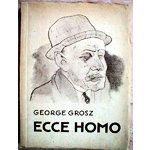
Here, as an aside, I should probably mention that before the story collection American Soma took the name of the principal story (a decision James made, and I don't disgree with), the collection was called Behold! Mankind. Why? Because it is the rough translation of George Grosz's portfolio satirizing mankind's immorality. (I intended no allusion to either Pilate or Nietzsche, only Grosz.)  Ecce Homo, published by Malik Verlag in 1923, was what landed Grosz in trouble with the authorities and, eventually, in court. Because American Soma offered small portraits of man's weaknesses, I felt there was a parallel in spirit and message.  (Also, if you read the story "Movie Star" in my first book, The Famous and The Anonymous, George Grosz appears as a character. I try to fit him into each fiction compilation because Grosz is my literary version of 'Nina'.)
George Grosz, "The Retreat" 1946
Back when I was in Munich, I was young (22 and then 23), determined, not easily daunted. I drank alot, and I saw in Grosz the nihilst, the rabble-rouser, the person who stirred dissent because he was young and prone to rebellion. I recognized a little of myself. 

When I got back to America, I began to discover a different Grosz, a disillusioned man, whose attempts to get away from his highly politicized past were met with criticism. Malcolm Cowley, who reviewed an exhibition of Grosz's American paintings for The Nation in the 1940s, castigated the artist for his decidedly apolitical tenor, for his tepid Cape Cod sand dunes, his comparatively academic nudes. Where, Cowley wanted to know, was the satirist? He was needed now more than ever. Apart from a few images representing the "haves" and the "have nots", Grosz abandoned social issues. 

I couldn't see it when I was 23 and 24, but I understand at 37 that Grosz was a haunted man, a broken man, as evinced by paintings like "The Retreat" of 1946. And knowing about the prescient dream he had in late 1932 that caused him to pack up his home and family and flee Germany before Hitler ascended to the position of Reichschancelor in 1933, it's easy to understand his pessimism. He had already seen that, ultimately, Stalin was little different than Hitler, something he revealed in a drawing appearing in the 1936 portfolio Interregnum. Ultimately, he resigned himself to the realization that man was so bogged down by weakness, desire, and corruption that he could never hope to achieve an equitable social or political system.

Malcolm Cowley, who castigated Grosz for
the artist's apoliticism in America
Why Cowley could not appreciate this, I'm not sure. Perhaps he was himself still an idealist. Perhaps he felt a man could not, or should not change. Grosz's attention to aesthetics over content was a conscious turn away from that which he knew could not be fixed. No amount of propaganda or artistic dissent would change the fundamental, corruptible nature of man. Ecce Homo indeed. Here, it seems, is the disappointing truth about man. Grosz knew this, and it is, I would wager, what contributed to his heavy drinking and, ultimately, his drink-related death.

Saturday, July 9, 2011

Neue Sachlichkeit und andere Geschichte

Weimar's New Woman:
short-haired, smoking, thin, intellectual.
August Sander photograph of Sonia Schad, wife of
Neue Sachlichkeit painter Christian Schad
(photo credit)
Darlings, let's have a flashback. Look there. Yes, just there, through the glass of the closed-door private study room on the second floor of the Juniata College Library. That's me, head bowed near the desk lamp, which creates a deceptive halo of light in my short blonde hair. I'm in a blue hooded sweatshirt and a pair of black jeans I've worn since eighth grade (so ripped in places that it is necessary for me to wear red or mustard colored tights underneath to remain socially acceptable).

Yes, okay. Sure, I'll admit it. I have added to the graffiti on the wooden desk inside this closed carrel. I come back each evening and find there is more to the animated graffiti conversation I'm having with some sports-obsessed wanker. Anyway, I'm done studying for the night, or maybe I'm taking a break. I have left the carrel for a moment, gone to the stacks, and pulled out a book on Neue Sachlichkeit (New Objectivity). This is the way I reward myself after I have to study something especially tedious, like biology.

On the cover of one of these books is a painting by Otto Dix of the German Journalist and Poet Sylvia "Sy" von Harden. I find the image vaguely revolting but also entirely fascinating. It is this regular visual communing with paintings, like the ones below, that marks the beginning of my obsession with what I consider (at the time) to be German Expressionism, although this was not Expressionism. It is the antedote to the emotion associated with Expressionism. It was a new kind of perspective, a perspective gained on the back side of the Treaty of Versailles, on the back side of starvation and horrible inflation. Gone are colorful representations of idyllic Primitivism. In their place is a representation of humanity's terrible imperfections, rendered with technical virtuosity and Duerer-like precision.

Otto Dix, Portrait of Sylvia "Sy" von Harden
This painting was recreated in an opening scene of
the film Cabaret.
And then, there are allegories, visual allegories on the perils and outcomes of war, like Rudolf Schlichter's "Blind Power" (below). Other paintings depict the almost syphilitic post-war excesses (and privations) of the politically precarious Weimar Republic. In November 2002, I wrote an article on this for the European Journal of Cultural Studies. The article considered three books dealing with three vastly different facets of Weimar. They were universally scholarly subject references, but ones which discussed vital period themes: 1) The New Woman and how she was shaped by popular literature, 2) The Culture of Spectacle, 3) the reciprocal relationship between the faltering economy and the culture it supported (and sometimes failed to fully support...the black market was wild in 1920s Germany).

I'll admit that I'm still entirely blown down by this period in history. And I'm blown down specifically by Europe in the 1920s and 1930s, not as much by America and its era of Prohibition and speakeasy culture. Our media outlets talk about the dire circumstances of contemporary society. But think was it must have been like for those who came home from inhuman (and inhumane) front experience, their feet likely rotting from weeks of immersion in water. Some were maimed, while many others were yet in a constant state of alert and fear that would never truly abate. And then they come home to what? Brown shirts, violent power struggles, a worthless currency. And almost complete chaos and degradation, thanks to the Versailles Treaty, a punitive tool that only made things much worse.

But I realize, yes, I'm rambling. I know. Over the past week, I've been working on a series of different things. I finished the Elgin story and have submitted it to Weird Tales. I've got another venue lined up once it's rejected, which it surely will be. This is the way of all literary things for me, it seems. It doesn't mean that I'll stop trying. Tonight, in Barnes and Noble, Michael pointed out to me the book A Confederacy of Dunces by John Kennedy Toole. I laughed a little when I saw this because I remember what happened to Toole, or more accurately what Toole did to himself in the face of such universal rejection. It's definitely not that I find it funny; I find it sad beyond words. I sympathize with him more that I care to go into here. We're all yelling into the wind, while the world blows crap in our faces. I feel that every time I sit down to write something. Sure, A Confederacy finally made it into print, but only after Toole's suicide and through the dogged determination of his mother, Thelma, and to Loyola University Professor Walker Percy. And then, low and behold, it won a Pulitzer. Now, why, publishers, was that so freaking difficult to accept? No, seriously.

Anyway, since it really might never see the light of day, here's a teeny tiny slice of Elgin:
"When it became necessary for the frieze to come down in smaller segments, Elgin suffered a blinding headache that lasted three days. Hunt came to his temporary quarters, where Elgin had asked for thick fabric to be drawn over the windows to block out the light. Hunt related the details in solemn whispers. “I suppose,” said Elgin, his thin palm over his damp forehead, “if it must be done to get them out, then it must be done. Try not to disfigure them any more than is necessary. Save them as best you can.”
Athena did not appear in Elgin’s dreams again. As he lay still in the swelter of his small Athens apartment, waiting for the sun to set, the heat to abate, for his the headache to lift, he experienced ocular fireworks, the flashing of strange geometric shapes, and a disturbing delusion that there were snakes around the base of his bed. But there was no ivory-skinned goddess. He longed for her approval. At one point, in the cool clamminess of night, he woke to shouting, but realized, on fully waking, that it was his own voice he heard. The words still filtered through his consciousness: Have I done right by you? Have I done right?"  -- from "The Metope Prophecy"

Wednesday, June 29, 2011

Savannah does Pete Townsend pinwheels....

So, kids, it's been a busy week. You see, it's just before July 4th and there's much to do for the big bash on Monday. Most of the Guz clan is at the Outer Banks this week, which leaves the Bunster and me to get things ready for the holiday. This evening, I may get a crash course in the Kubota, so I can mow tomorrow. Okay, yeah, maybe 'crash course' was not the best word to use. I hope to crash into nothing. Michael is confident in letting me handle the fields, but not around the houses. Yeah, not so much. I make him nervous when I drive, so with a mower attached to the bottom, I represent an even greater danger. And I probably shouldn't admit that, yes, I can see that. 
Meet my supervisors: Jasper, on the sofa;
Fred, on the floor. This was their most
recent office visit. Apparently, my effort is
"ruff". Is this good or bad...anyone know?

Last night, we went up to visit the bees. I was wearing a tank top. This was a mistake. One especially zealous guard bee, who perhaps forgot that we're the ones who bring her hive sugar syrup, chased me all the way down the hill (all the way), while both my arms apparently did Pete Townsend-style windmills. According to Michael and Cousin Linda, who could see us from her backyard, I was quite the humorous sight. I did get stung--in the middle of my upper back, where I couldn't reach it to get the venom pumper out. So, my yelling was warranted. Michael said, when he got down to me to flick the stinger out (and after he stopped laughing), "Damn. You can really run fast in those flip-flops." There will be no more visiting the hill without my bee suit. Period. No, on second thought, make that an exclamation point.

So, I'm working on Charlotte, as mentioned in my previous post. I'm lengthening and adding scenes, correcting factual inaccuracies, and doing research. As I find scenes in the historical literature, I work on chapters. Yesterday, I found a fascinating article, written for the Block Museum of Art at Northerwestern, titled "Last Expression: Art from Auschwitz" by Guido Fackler. It details the use of music for purposes of psychological degradation in the camps. However, some of the women, in apparently rare cases, would actually use music as a form of resistance. There is documentation of the women singing La Marseillaise on returning from work details, when they were undoubtedly exhausted and sometimes (or perhaps often) forced to carry their dead comrades back to barracks with them. It's this spirit of resistance in the face of apathy and terror that I am most interested in.


Meanwhile, I'm also working on other speculative fiction. I've got a story going this morning about Thomas Bruce, 7th Lord Elgin. You know him. He's the man who has been blamed for theiving away much of the Parthenon freize and pediment sculptures when he was ambassador to the Ottoman Empire between 1799 and 1803 and when the Turks had little appreciation (and probably a whole lot of disdain) for the work of Phidias. Elgin, who hoped to save these treaures--which eventually inspired sculptors like Canova--suffered a great deal of life misfortune and has been pretty harshly judged by history. So, he's inspired a story...here's part of it.

That night, while composing letters at his writing table, he fell asleep. He dreamed he was back in the darkened sanctuary near the Amazon whose skin had the pale faultlessness of unglazed porcelain. Her gold gown radiated its own warmth, which made him drowsy. He was a youth again, no older than fourteen or fifteen, and lay on his hip beside the reflecting pool, the cool marble against his cheek. In his right hand was a tiny wooden boat, a toy he recognized from his childhood. Languidly, without significantly shifting his position, he set the boat on the surface of the water. When it merely floated calmly on the surface, he pushed it gently with his finger towards the dais opposite him. He vaguely registered that the giantess above him was alive. Her eyes followed him even as her towering body remained entirely still, her face motionless. The boy looked away from boat, which moved steadily towards her. He cast his gaze up to her face, and when his brown eyes met the lapis colored stones representing hers, she leaned forward from her exalted position and whispered to him, “Save me.”

Now, back to work....but before I go, have a video moment. I know, pardon me. I'm again late coming to this party, since, apparently, this has been everywhere. But I have a tendency to get stuck on weird stuff and then put them on repeat play for months on end. Anyway, I just discovered Brandi Carlisle, and HOLY CRAP, the girl has some freaking powerful voice.  http://youtu.be/o8pQLtHTPaI

Thursday, June 23, 2011

Charlotte's Nexus

It's been quiet, I know. So what am I working on, you ask? I'll tell you. (she lays her cards out on the table in a perfect fan shape...look, a full house)

Let's go back in time. It's the late summer of 2007. I'm waiting for the now apparently defunct So New to publish my book, which will eventually become American Soma. It is a long wait, and the book's publication is still two years away, although I don't know this yet. But, darling, that's another story.

Picture me holding a plastic shopping bag, kneeling in a large patch of Blue Lake Bush Beans. I'm picking pods to preserve while Michael replaces pads on my truck in a garage several meters away. That year, we can 75 Ball Jars of Blue Lake Beans, an amazing amount. Picking beans is a Zen activity, requiring little mental effort because the plants are yellow and the beans are thick and green, easy to spot. In this bean patch, I get an idea, which grows from an idea I carried with me on a disc from Pennsylvania...an idea that eventually grows into this.

This new idea hits me in that bean patch so hard it makes me cry. I wonder, for a few moments, about my sanity.

By then, I have started teaching, and during my long drives down Route 7 to Wheeling, I put together the images that comprise the following six flash works, some of which I read at the 5:10 Reading Series in Baltimore a year later:
"Charlotte, Ionized"
"Charlotte, the Apparition"
"Charlotte's Nexus"
"Arrival at the Camp"
"The Doctor Dreams"
"Fugitive Doctor"

After American Soma is finally released (and I beat my head against the wall with the publisher for months afterwards), I stop working on Charlotte's story. Other things eclipse her. I fail to hear her whispering in my ear for a long while.

Charlotte is back. And this time, I will finish her story.

"He himself was smooth-shaven, close-pored, every nail crescent scrubbed white. He brought the smell of clean laundry with him, too. And there was music, beautiful trills and noise her mind tried to record so she could hear it later, at night, when the lights over the wooden bunks were out. She would catch a remembered resonance and hang on to it. Where could it take her? Back into the office, back over the bones and teeth that scattered over the man’s desk? Back to the wash line where her mother stood pinning clothes and dish rags to the white cord that ran between houses? To the man at the dinner table, an uncle, who speared meat with a three-pronged fork and winked at her as he did it?


Did he, this doctor, look very much like my father? She couldn’t remember. She just couldn’t remember. No image came, only a swelling in her throat."

Thursday, June 16, 2011

Who is Alan F. Reiland?

Recently, I went in to Shaw Galleries, downtown, to see the photography exhibition "Forgotten Witness: The Long Lost Photographs of Pittsburgh Press Photographer Alan F. Rieland". If the arts & entertainment editor at CP can work it out, my article on the show will appear next week. Still waiting for confirmation. In truth, it's not really a review, although I do offer a little qualitative discussion on the power of the photos. Nevertheless, the article talks more about the mystery behind the photographs.

"Complaint Department (Self-Portrait)"
by Alan F. Reiland

image courtesy Kurt Shaw, Shaw Galleries
Who, exactly, is the Pittsburgh Press photographer Alan F. Reiland? He seems to have come from nowhere, left few historical traces, and died in obscurity.

But, wait. Let's back up and talk about how he was 're-discovered' at all. Reiland's 24 or so gelatin silver prints were first found on the floor of the Pittsburgh Press Building, where they had been for decades. They were almost thrown away during the merge with the Post-Gazette in 1992. But some astute soul rescued them, kept them for a decade and then sold them to someone else. This unknown someone-else had an estate sale in 2006. At this very estate sale, Shaw Gallery Owner Kurt Shaw saw them for the first time and purchased them (Please go see the show! It's up until June 30th!).

What appears in the exhibition are the prints (certainly, there are no negatives known to exist) still in their original cream-colored mats. These mats bear shoe prints and broad smudges of dirt. Remember, they were lying on the floor of the press building since the 1960s, so essentially, part of their physical history is also on display.

Shaw told me that in anticipation of the exhition, he'd done some research, attempting to track down Reiland over the previous five years. Based on Shaw's (and now my own) search of Social Security records, we know he was born in 1927 and died in Munhall, a borough adjacent to Homestead, on August 30, 1996. But when Shaw contacted neighbors in Munhall and a local upholstery company that goes by the name of Reiland, no one knew the man or even remembered him. Apparently, he had no surviving relatives.

I like a good mystery. And I'll admit that I've developed a fascination with Reiland over the past days, since I spoke with Kurt Shaw and saw the photographs. How can a man appear and disappear, just like that? Certainly there have to be census records, payroll records. Did the man bud, fully formed, from someone's head or perhaps land from the sky? Well, I finally signed up for Ancestry.com, and I got more information: his social security number, his old phone number, and two separate residence addresses. But that's about it. There's no evidence of co-habitation with anyone, no evidence of children, no evidence that he ever had a father or mother. In fact, before 1983, there seems to be no mention of him at all, unless he changed his name from Alaric, which I suppose is entirely possible. Yet Alan's birth date is firm, while Alaric's carries the dubious 'about' designation and is a year later than Alan's. So, the mystery continues.

Next week, I plan to do some more investigating at the Carnegie Library's Pennsylvania Room, where I'll scan a specific part of the microfilm collection. In the meantime, I've included a picture above, a staged picture that he took. It is intended as a self-portrait and suggests his sense of humor. Its title, of course, is "Complaints Department".